Singapore's bird checklist exceeds 400 species, a number that reflects the island's position on the East Asian-Australasian Flyway and the diversity of habitats packed into a small area. This guide covers the species most frequently encountered by birders, with field identification notes, habitat preferences, and typical locations.
Species are grouped by habitat type rather than taxonomy, since most birders organise their outings around specific locations.
Wetland and Coastal Species
White-bellied Sea Eagle (Haliaeetus leucogaster)

Size: 70-85 cm body length, wingspan up to 2 metres. The largest raptor regularly seen in Singapore.
Identification: Adults have a clean white head, breast, and belly contrasting with grey upperparts and dark flight feathers. In flight, the broad wings show a distinctive two-tone pattern from below: white leading edge, dark trailing edge. The short, wedge-shaped tail is white. Juveniles are brown with pale streaking, gradually acquiring adult plumage over 4-5 years.
Where to see: Sungei Buloh Wetland Reserve (most reliable), Kranji Marshes, Pulau Ubin, and along the northern and southern coastlines. Often seen soaring on thermals above the treeline.
Notes: This eagle hunts fish and sea snakes from the air, plunging feet-first into the water. Pairs are territorial and tend to use the same nesting trees year after year.
Collared Kingfisher (Todiramphus chloris)

Size: 23-25 cm.
Identification: Bright turquoise-blue upperparts with a broad white collar and white underparts. The large, heavy bill is dark above and pale below. The call is a loud, repeated "kee-kee-kee" that carries well across open habitats.
Where to see: One of Singapore's most widespread species. Found in mangroves, parks, gardens, and along the coast. Common at Sungei Buloh, Pasir Ris Park, and East Coast Park.
Notes: Unlike many kingfisher species, the Collared Kingfisher feeds on insects, lizards, and crabs in addition to fish. It nests in tree cavities and has adapted well to urban habitats.
Grey Heron (Ardea cinerea)

Size: 90-98 cm, with a wingspan of approximately 175 cm.
Identification: A large, long-necked wading bird. Adults are predominantly grey above and white below, with a white head bearing a black stripe that extends from above the eye to a short occipital crest. The long, dagger-like bill is yellow-orange. In flight, the neck is retracted into an S-shape (a key distinction from cranes and storks, which fly with necks extended).
Where to see: Sungei Buloh, Kranji Marshes, Singapore Botanic Gardens. Often stands motionless in shallow water, waiting to strike at fish and frogs.
Little Egret (Egretta garzetta)

Size: 55-65 cm.
Identification: Entirely white plumage with a slender black bill, black legs, and distinctive bright yellow feet. In breeding plumage, develops long plume feathers on the nape. The yellow feet are a reliable field mark that separates this species from the larger Great Egret.
Where to see: The most commonly encountered bird at Sungei Buloh according to eBird data. Also present at Kranji Marshes, Jurong Lake Gardens, and along drainage canals across the island.
Common Redshank (Tringa totanus)
Size: 27-29 cm.
Identification: A medium-sized wader with bright orange-red legs and a red-based bill with a dark tip. In non-breeding plumage (which is how it appears in Singapore), the upperparts are grey-brown with fine white fringes. In flight, shows a distinctive white wing-bar and white rump.
Where to see: Sungei Buloh Wetland Reserve, particularly the Migratory Bird Trail. Present August to April.
Notes: One of the most numerous migratory waders at Sungei Buloh, with over 1,600 eBird observations recorded. Often found in mixed flocks with Common Greenshanks and Common Sandpipers.
Forest Species
Greater Racket-tailed Drongo (Dicrurus paradiseus)

Size: 32-36 cm (body), with tail streamers adding up to 28 cm more.
Identification: Entirely glossy black with a slight blue-green sheen. The most distinctive feature is the pair of elongated outer tail feathers that end in twisted, spatula-shaped rackets. A small frontal crest is sometimes visible. The bill is stout and slightly hooked.
Where to see: Bukit Timah Nature Reserve, Central Catchment Nature Reserve. Usually perches at mid-canopy level and is more often heard than seen initially.
Notes: This species is one of the most accomplished vocal mimics among Asian birds. A single individual may reproduce the alarm calls and songs of 10-15 other species. It regularly follows mixed-species foraging flocks and Long-tailed Macaque troops through the forest, catching insects disturbed by their movement.
Oriental Pied Hornbill (Anthracoceros albirostris)

Size: 55-60 cm.
Identification: A medium-sized hornbill with black upperparts and white belly. The pale yellowish bill supports a prominent casque (larger in males). White patches on the outer tail feathers and trailing wing edge are visible in flight. The wingbeats produce a distinctive whooshing sound audible from a distance.
Where to see: Pulau Ubin (the stronghold), Pasir Ris Park, Bishan-Ang Mo Kio Park, Jurong Lake Gardens. Protected under the Wildlife Act administered by AVS.
Notes: Singapore's hornbill population has expanded significantly from a small founding group on Pulau Ubin. The species has colonised the mainland and is now seen in suburban parks. It feeds primarily on fruit, particularly figs.
Red-crowned Barbet (Psilopogon rafflesii)
Size: 24-27 cm.
Identification: A stocky green bird with a vivid red cap extending from the bill to the nape. Light blue markings on the chin and throat. The rest of the body is leaf-green, making it surprisingly well-camouflaged despite its colourful head. The call is a low, soft cooing of 6-7 notes that start quietly and rise in volume.
Where to see: Largely restricted to Bukit Timah and the Central Catchment Nature Reserve. Look for it foraging on the ground for fallen fruit or feeding in fruiting trees and vines.
Urban and Garden Species
Crimson Sunbird (Aethopyga siparaja)

Size: 11-14 cm.
Identification: Males are striking: deep crimson-red head, breast, and mantle with an iridescent blue-purple throat patch and olive-green belly. The long, curved bill is designed for nectar feeding. Females are much plainer, olive-green above and pale yellow below, with the same curved bill.
Where to see: Gardens by the Bay, Singapore Botanic Gardens, and flowering gardens across the island. Often seen hovering briefly at flower clusters.
Pink-necked Green Pigeon (Treron vernans)
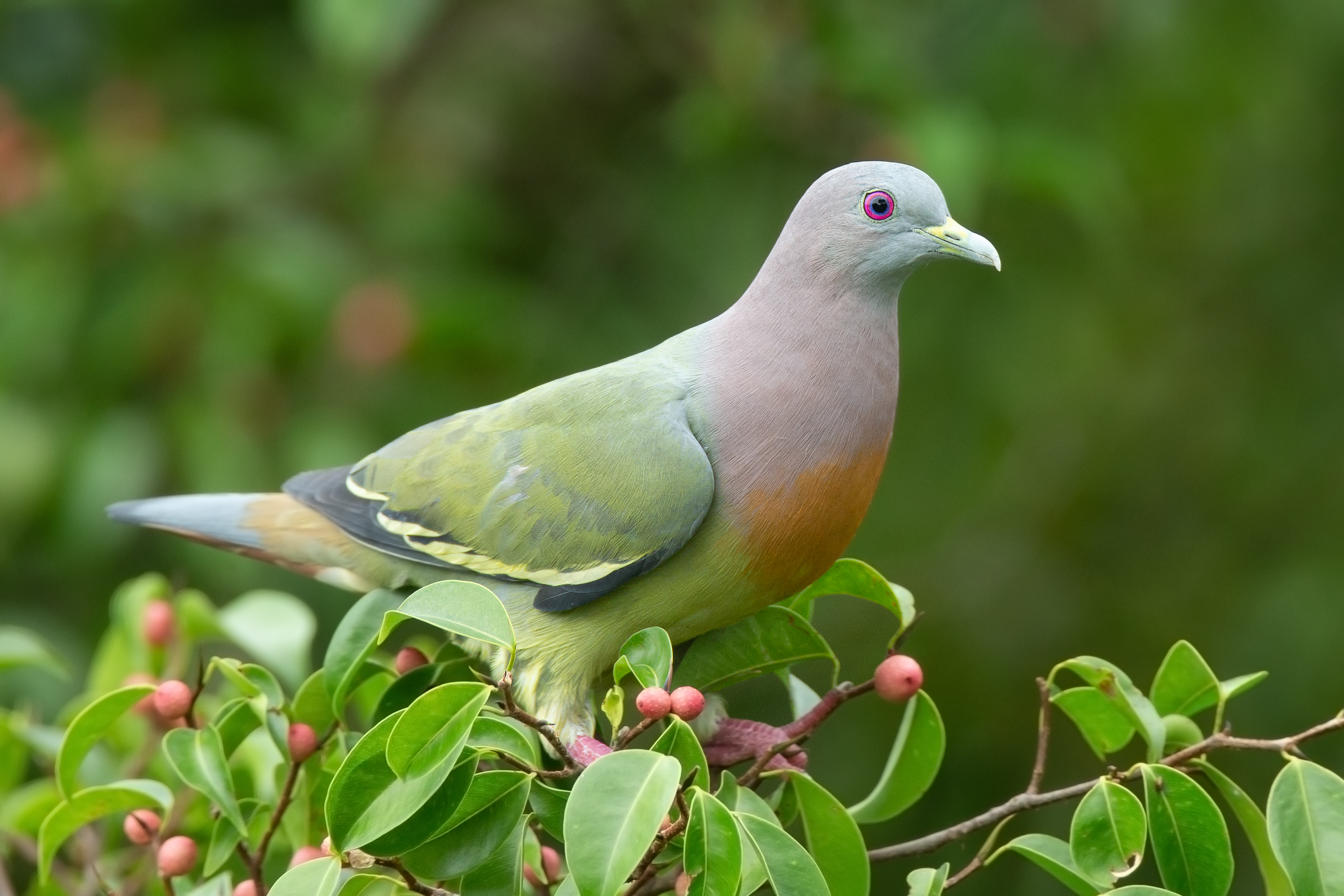
Size: 26-30 cm.
Identification: Males have a grey head with a distinctive pink-orange wash on the neck and upper breast, green upperparts, and an orange-yellow belly. Females are entirely green with a paler belly. Both sexes have short, stout bills and red feet.
Where to see: Found across all three major habitat types in Singapore (forest, wetland, urban). This is the only species to appear in the top-10 eBird observation lists for Sungei Buloh, the Central Catchment, and Jurong Lake Gardens simultaneously. It is the centrepiece of the Nature Society Singapore logo.
Javan Myna (Acridotheres javanicus)
Size: 21-25 cm.
Identification: The most commonly recorded bird in Singapore overall. Entirely dark grey-black plumage with a white wing patch visible in flight. Bright yellow bill, eye ring, and legs. Often found in noisy groups in urban areas.
Notes: An introduced species that has become the dominant urban bird. Originally from Java, it has displaced the native Hill Myna in many areas.
Migratory Waders (August-April)
Pacific Golden Plover (Pluvialis fulva)
Size: 23-26 cm.
Identification: In non-breeding plumage, golden-brown and speckled above, with a pale face and breast. In breeding plumage (occasionally seen in late March-April before departure), develops a bold black face and underparts bordered by white. Distinguished from the similar American Golden Plover by slightly shorter primary projection and warmer golden tones.
Where to see: Sungei Buloh tidal mudflats, Marina East Drive, and open grassy areas near the coast.
Whimbrel (Numenius phaeopus)
Size: 40-46 cm.
Identification: A large wader with a long, down-curved bill. Warm brown plumage with pale stripes on the crown. The bill shape separates it from all other regularly occurring waders in Singapore. The call is a rapid series of seven whistled notes, often given in flight.
Where to see: Sungei Buloh, Mandai Mudflats, and along the northern shoreline.
Recommended Field References
- "A Field Guide to the Birds of South-East Asia" by Craig Robson (New Holland Publishers)
- "A Naturalist's Guide to the Birds of Singapore" by Yong Ding Li and Lim Kim Chuah
- The eBird Singapore database for real-time species lists and hotspot data
- The Merlin Bird ID app (by Cornell Lab of Ornithology) for photo and sound identification
- singaporebirds.com for local species accounts, photographs, and checklists